
Charm King
PlayQ IncPuzzle
4.249.85K Reviews
- Version
- 8.15.8
- Installs
- 10.00M
- Age Rating
- Everyone
Screenshots
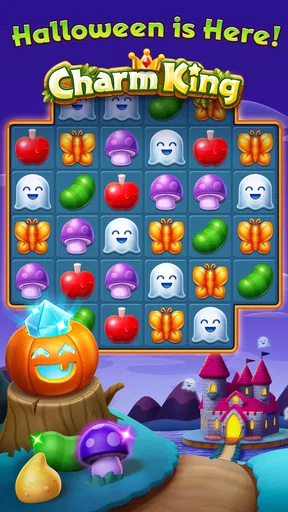
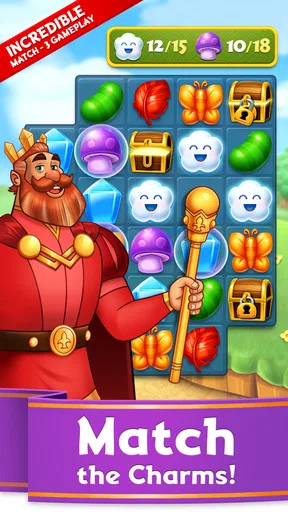
Our Review of Charm King
 Analysis by Appyee
Charm King is the kind of puzzle game I can open with no preparation, make a few matches, and understand immediately whether I have time for one more round. Its central action is familiar: I swap nearby pieces to line up matching charms, watch the board react, collect the resulting reward, and decide whether to continue or put the phone away. That simplicity is the main attraction, but it also makes the game easy to judge. If you want a calm match-three experience with a bright presentation and a gentle learning curve, this game is worth considering. If you need deep strategy, a completely pressure-free structure, or a puzzle system that feels radically different from the usual alternatives, you may eventually want something else.
How the match-three loop feels in actual play
I find the match-three loop easiest to enjoy when I treat each move as a small choice about what the board should look like next, rather than simply clearing whatever match catches my eye. That approach gives a quick session a little more intention without turning it into homework. It also makes the game’s familiar rhythm easier to assess: the next section looks at how that simple design sits within its longer life and current version.
The first action is clear, quick, and welcoming
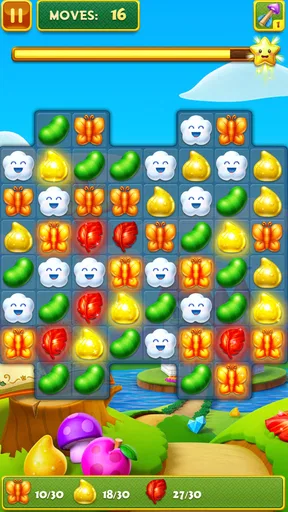
My first useful impression came from how little effort it took to begin. I did not need to study a complicated rulebook or remember a long list of controls. The board presents a collection of charms, and the basic decision is to move one into a neighboring position to create a match. That first successful combination gives immediate visual feedback, so the relationship between action and result is easy to understand even for someone who rarely plays puzzle games.
This accessibility makes the game a good fit for short breaks. I can play while waiting for an appointment, during a quiet commute, or at the end of the evening when I want something more interactive than scrolling but less demanding than an action game. The age rating is Everyone, and that matches the approachable design. Younger players can grasp the objective quickly, while adults who prefer uncomplicated mobile entertainment can start without a long onboarding process.
The important detail is that the first move is not only about clearing charms. It also teaches me to look at the whole board before acting. A match that seems obvious may be less useful than a move that opens space, creates a chain, or leaves better possibilities for the next turn. I found that this small change in attention separates random tapping from satisfying play. The game is easy to enter, but playing well still asks me to pause briefly and choose rather than move automatically.
That makes Charm King more comfortable than puzzle games that begin with a dense screen full of currencies, menus, and competing objectives. Here, the board remains the focus. I can understand what I am doing within seconds, which is exactly what I want from a casual game. The trade-off is that players who enjoy a dramatic opening, a complex tutorial, or a strong narrative hook may find the initial experience modest.
Every match creates a readable feedback rhythm
The pleasure comes from the rhythm after the move: charms connect, the board changes, and the result tells me whether the decision was useful. A simple match gives a small sense of progress, while a more efficient move feels better because it improves the position rather than merely removing pieces. That feedback encourages another look at the board instead of making every turn feel interchangeable.
I especially like the way this rhythm supports a relaxed pace. I am not required to react at the speed of an arcade game. I can inspect possible matches, think about what might fall into place, and then commit. The visual response confirms the choice without demanding that I memorize complicated combinations. This is where the game’s promise of relaxation makes sense in practical terms: the challenge is present, but it is expressed through observation and selection rather than frantic control.
There is still a meaningful difference between a lucky move and a planned one. When several matching options are available, I try to favor the move that leaves the most open space or creates a better follow-up. That is a useful habit for new players: do not automatically choose the largest-looking match. Look for the move that improves the next decision as well. In a game built around repeated boards, this simple approach helps keep the loop from becoming pure chance.
The feedback also gives each turn a natural stopping point. After the board settles, I can reassess rather than feeling rushed into another action. That matters for people who want a game they can play with half their attention, although it may disappoint players who prefer constant pressure and rapid decision-making. Charm King sits closer to thoughtful casual play than to competitive speed puzzling.
Rewards make progress feel immediate, not abstract
A match is satisfying because it produces a visible result right away. The reward is not only the cleared space; it is the sense that the board has become more manageable and that my decision has moved the round forward. This immediate response is a strong reason the game works well in short sessions. I do not need to wait for a large milestone before feeling that I have accomplished something.
That said, the reward loop is best understood as a steady series of small wins rather than a single spectacular payoff. I make a match, see the board respond, evaluate the new arrangement, and repeat. The game’s appeal depends on whether those modest moments are enough for me. They are enough when I want a calm diversion. They are less convincing when I am looking for a puzzle game with elaborate planning, a rich story, or a highly competitive endgame.
One practical tip is to treat the reward as information. A successful match tells me which areas of the board are opening and which pieces are becoming obstacles. Instead of chasing every immediate combination, I use the aftermath to decide where my attention should go next. This makes the play feel more deliberate and helps prevent the common match-three habit of staring only at the most obvious group.
The free price also lowers the barrier to trying it. I can install the game without paying upfront and decide from actual play whether the loop suits me. There are in-app purchases ranging from $0.99 to $99.99 per item, so I would approach the purchase system thoughtfully. Anyone who wants a purely no-spend experience should set a personal boundary before getting absorbed in repeated rounds. The game can be enjoyed as a free download, but the presence of optional spending means it is worth paying attention to purchase prompts rather than treating every offer as part of the puzzle itself.
The reset between rounds is what invites another session
After a round ends, the game gives me a natural reset: the immediate board is finished, the tension of that arrangement disappears, and a fresh decision waits. That reset is important because it keeps a difficult or imperfect attempt from feeling permanent. I can try again with a different approach, or I can stop at a convenient point without needing to remember a complicated position for later.
This is also where the game’s casual identity becomes clearest. The reset makes it easy to fit into everyday routines. For example, if I have ten quiet minutes before leaving home, I can complete a short burst of play, put the phone down, and return later without feeling that I abandoned a long campaign. On a tired evening, I can use it as a small mental change of pace: make a few careful matches, enjoy the visual response, and stop when the activity no longer feels refreshing.
The same quality can work against long-term engagement for some players. A reset is comforting, but it can also make the experience feel repetitive if the core action does not continue to surprise you. Players who need a strong sense of character development, persistent world-building, or a constantly changing strategic system may find the loop too circular. I would not choose this as my main game if my goal were a deep, long-form challenge.
My advice is to use the reset intentionally. Play it as a break rather than promising yourself an extended marathon. That approach keeps the relaxing quality intact and reduces the chance that the repeated cycle starts to feel like routine work. It also makes the game easier to recommend to people who want a simple puzzle they can pick up and leave without consequences.
Small decisions matter more than fast tapping
Although the controls are simple, I found three habits particularly useful. First, I scan for matches that improve the next move instead of immediately taking the first available option. Second, I pay attention to the space created after a match, because an open area can be more valuable than a single larger-looking combination. Third, I pause after the board settles. That brief reset prevents me from acting on an outdated view of the pieces.
These habits are not advanced systems hidden behind a complicated interface; they are ways of getting more value from the board that is already in front of me. They also explain why the game can remain pleasant after the initial novelty fades. The challenge is not learning dozens of rules. It is improving the quality of ordinary decisions and noticing how one move changes the next.
For families, this makes the game easy to share informally. Someone can explain the basic action in a moment, then let a new player learn through the board’s response. For solo players, it offers a low-pressure way to practice visual planning. I would be more cautious recommending it to anyone who dislikes repeated matching mechanics, because the accessible structure is also the source of its predictability.
Where it stands beside familiar puzzle alternatives
Compared with more intense match-three games, Charm King feels less focused on speed and spectacle. Its strongest quality is the smooth connection between a simple move and an understandable result. Compared with minimalist puzzle games built around a single elegant rule, it is more colorful and immediately inviting, but it may not offer the same sense of abstract discovery. Against story-heavy puzzle adventures, it is easier to enter but less likely to become a narrative destination.
That comparison helps clarify who should choose it. I would pick Charm King over a demanding puzzle title when I want a forgiving, familiar activity for short sessions. I would choose a more strategic alternative when I want to plan several moves ahead or solve a board that feels like a carefully constructed logic problem. I would choose a narrative game when characters and story are the reason I am playing. Charm King succeeds by staying focused on the matching loop rather than trying to be all of those things at once.
The game comes from PlayQ Inc and has been available since Apr 1, 2014. Its continued presence is reflected in a 4.2 average from around 510 thousand ratings, with over 10 million installs. Those figures suggest a broad audience, but they do not replace personal fit. A popular casual game can still be the wrong choice if you need unusual mechanics or dislike purchase prompts. I see the reach as evidence that the basic loop is approachable, not as a reason to overlook its limitations.
Who will enjoy it, and who should skip it
I recommend it to people who like familiar match-three play, want something suitable for short breaks, and prefer a calm pace over rapid reactions. It is also a sensible option for a first puzzle game because the main interaction is easy to understand and the board itself communicates what to do. The Everyone rating reinforces that broad accessibility.
I would skip it if I become bored by repeating the same kind of decision, need a substantial story, or want a competitive puzzle environment where every second matters. I would also be careful if I am trying to avoid all in-app purchase temptation. The free entry is useful, but I should still manage spending deliberately, especially because the available items extend from small purchases to much larger ones.
Device compatibility is straightforward for many users: the current version is 8.15.8 and the game requires Android 7.0 or later. That makes it a practical candidate for older compatible Android phones, though I would still keep the operating system updated when possible. The version detail is useful when deciding whether an older device is likely to support the installation, while the free price makes testing the experience relatively simple.
My verdict on the complete action-to-reset loop
Charm King works because every part of its cycle is easy to read. I make a move, receive immediate feedback, gain a small reward from the cleared board, and reach a clean reset that makes another attempt feel optional rather than forced. That structure is reassuring, and it explains why I can return to it for a few minutes without needing a large block of free time.
Its weakness is the same as its strength: the loop stays close to the familiar match-three formula. The game does not need complicated systems to be enjoyable, but players seeking a more distinctive puzzle identity may outgrow it. I also think the purchase range deserves sensible boundaries from the start, even though the game itself is free to download.
For me, the best way to play is to focus on board quality rather than speed. I look for a move that creates a useful follow-up, watch how the charms settle, and stop when the reset feels like a natural pause. If that sounds like the kind of small, repeatable satisfaction you want, Charm King is an easy game to try. It is not the deepest puzzle option on mobile, but as a friendly match-three break with a clear action, response, reward, and restart, it earns its place in my casual rotation.
Verdict
Strengths of Charm King
- Colorful graphics and charming animations make levels enjoyable.
- Simple match-3 controls are easy for new players to learn.
- Hundreds of levels offer plenty of content for casual sessions.
- Boosters help clear difficult boards and create satisfying combos.
- Works well for short play sessions during commutes or breaks.
Limitations of Charm King
- Later levels can become highly dependent on lucky tile layouts.
- Lives limit continuous play unless you wait or use extra resources.
- Frequent events and rewards may encourage regular check-ins.
- Some boosters and resources can be expensive to obtain.
- Gameplay may feel repetitive for players seeking deeper strategy.
Other Releases by PlayQ Inc
View All
Treasure Party: Puzzle Fun!
Puzzle4.6
Similar Picks in This Category
View All
Block Blast!
HungryStudio4.8

Braindom: Brain Games Test
Lahana Game Studio4.6

AMAZE!
CrazyLabs LTD4.6

Sudoku - Classic Sudoku Puzzle
Oakever Games4.7

Art Puzzle - Puzzle Games
Easybrain4.8

Amaze GO!
Oakever Games4.9
Frequently Asked Questions
What is Charm King, and how is the game played?
Charm King is a colorful match-three puzzle game in which you swap adjacent pieces to create lines of three or more matching charms. Completing matches clears the board and helps you meet level objectives, such as collecting specific items, removing obstacles, or reaching a target score. The game is easy to understand, but later stages introduce more challenging layouts, limited moves, and special combinations.
Is Charm King free to download and play?
Charm King can generally be downloaded and played for free, allowing you to progress through many levels without an upfront purchase. However, the game may include optional in-app purchases for extra lives, boosters, coins, or other conveniences. These purchases are not usually required to enjoy the core gameplay, although players who want faster progress or additional attempts may encounter purchase offers during difficult levels.
Does Charm King require an internet connection?
Many of Charm King’s basic puzzle levels may be playable without a constant internet connection, which is useful when traveling or playing in areas with weak reception. Nevertheless, an internet connection can be required for features such as advertisements, purchases, account synchronization, events, updates, or leaderboard access. Availability of offline features may also vary depending on the version installed and the device being used.
Are there advertisements or in-app purchases in Charm King?
Charm King may contain advertising and optional in-app purchases. Advertisements can appear between levels or when you choose to receive an extra reward, while purchases may provide coins, boosters, lives, or other gameplay benefits. Before downloading, parents and players should review the store listing and device purchase settings, especially if children will use the app, because spending can occur through the connected app store account.
Is Charm King suitable for children and casual players?
Charm King is designed to be accessible to casual players, with simple controls, bright visuals, and short levels that are easy to play in brief sessions. Its puzzle format is generally family-friendly, but difficulty and monetization can become more noticeable as you progress. Parents should check the current age rating, privacy information, advertising practices, and in-app purchase controls before allowing younger children to play independently.
Play our best games!


